

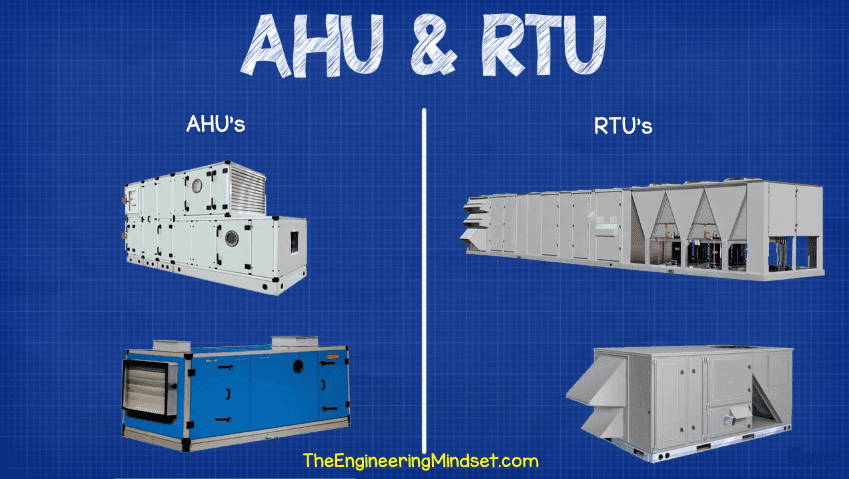
When it comes to commercial HVAC systems, two of the most common options for managing airflow and temperature control are Air Handling Units (AHUs) and Rooftop Package Units (RTUs). Both offer unique advantages, but the choice between the two can be daunting. Factors like installation complexity, maintenance, efficiency, and lifecycle costs all come into play when selecting the right system for your building.
In this blog, we will explore the differences between AHUs and rooftop units, helping you understand their strengths and weaknesses, and guide you through how to choose the right HVAC solution based on your project needs.
What is an Air Handling Unit (AHU)?
An Air Handling Unit (AHU) is a central HVAC system component used to condition and circulate air throughout a building. AHUs are typically part of a larger, more complex HVAC system, often connected to ducts and other components to regulate air quality, temperature, and humidity.
Key Features of AHUs:
Components: AHUs include fans, heating/cooling coils, filters, and dampers. Some units can also incorporate humidifiers and dehumidifiers.
Customization: AHUs can be highly customized to meet the specific needs of the building. This includes varying the size, airflow, filtration, and type of coils used.
Centralized Control: They typically serve large commercial or industrial buildings and are designed for centralized air distribution, meaning they distribute air through a network of ducts to various parts of the building.
When to Use AHUs:
Large buildings with complex heating and cooling needs
When precision air control (humidity, filtration, temperature) is necessary
Buildings with space for larger equipment, often requiring a dedicated mechanical room
What is a Rooftop Package Unit (RTU)?
A Rooftop Package Unit (RTU) is a pre-assembled, all-in-one HVAC system designed for installation on the roof of a building. RTUs are designed to handle both heating and cooling needs, often used in commercial buildings such as retail spaces, small offices, and industrial warehouses.
Key Features of RTUs:
All-in-One Design: RTUs integrate the compressor, condenser, evaporator, and blower into a single unit, making installation simpler and more space-efficient.
Compact: The unit is mounted on the roof, freeing up valuable space inside the building, which is a big advantage for buildings with limited interior space.
Energy Efficiency: Modern RTUs are often energy-efficient and come equipped with advanced features like variable speed fans and energy recovery systems.
When to Use RTUs:
Small to medium-sized buildings with limited internal space
For areas where rooftop installation is feasible and preferred
Projects that require a simpler and more cost-effective HVAC solution
Comparing AHUs and Rooftop Units
When deciding between an AHU and an RTU, it’s important to consider a range of factors, including airflow, filtration, installation complexity, lifecycle costs, and maintenance requirements.
1. Airflow and Filtration
| Factor | AHU | Rooftop Unit |
| Airflow Control | High flexibility, able to accommodate various airflow configurations, including variable airflow and zone control | Typically offers standard airflow configuration, not as customizable as AHUs |
| Filtration | Can incorporate advanced filtration systems, including HEPA filters and UV air treatment systems | Generally comes with basic filtration, but can be upgraded with higher-quality filters |
| Flexibility | Offers more flexibility in terms of airflow, heating, cooling, and filtration systems | More limited in customization for filtration and airflow control |
AHUs are generally the superior option when it comes to customized airflow and filtration. They can be equipped with high-efficiency filters, UV lights, or humidification systems. This is especially useful in environments where air quality is critical, such as hospitals, laboratories, and office buildings.
On the other hand, Rooftop Units typically provide more basic filtration options but are adequate for most standard commercial spaces like retail stores, small offices, and warehouses.
2. Installation and Space Requirements

| Factor | AHU | Rooftop Unit |
| Installation Complexity | Requires space for mechanical rooms, ducting, and professional installation | Simple installation on the roof, with minimal interior disruption |
| Space Requirements | Requires considerable interior space for installation and ductwork | Compact design, freeing up valuable interior space |
AHUs are ideal for larger buildings where there is space to accommodate mechanical rooms and ductwork. However, installation can be more complex and time-consuming due to the need for ducts and ventilation systems.
Rooftop Units, on the other hand, are much simpler to install because they come pre-assembled and are mounted on the roof. This can save interior space and reduce the need for extensive ductwork. They are often the preferred choice for smaller buildings or buildings with limited space inside.
3. Lifecycle Costs (TCO)
| Factor | AHU | Rooftop Unit |
| Upfront Costs | Generally higher due to customization, installation, and complexity | Lower upfront cost due to simpler installation and pre-assembly |
| Maintenance Costs | Can be higher due to the complexity and need for regular servicing of various components | Typically lower maintenance costs, but may require frequent filter changes |
| Energy Efficiency | Can be designed for optimal energy efficiency based on building needs | Energy-efficient models available, but often less flexible in optimization |
AHUs have higher upfront costs and installation complexity. However, because they can be tailored to the specific needs of a building, they may offer better long-term energy efficiency and comfort, leading to lower operating costs over time.
Rooftop Units are more cost-effective to install and maintain, but they may not be as energy-efficient or flexible in customization. For buildings with relatively simple HVAC needs, RTUs can offer a cost-effective solution with a lower total cost of ownership (TCO).
4. Performance and Reliability
| Factor | AHU | Rooftop Unit |
| Performance | High performance, capable of handling complex heating, cooling, and ventilation needs | Suitable for basic heating and cooling with fewer options for customization |
| Reliability | Very reliable when maintained, but complex systems may require more frequent servicing | Reliable for basic HVAC needs with less complexity, leading to lower risk of failure |
AHUs generally provide superior performance, especially in large buildings with complex needs. However, the complexity of the system may result in more maintenance requirements.
Rooftop Units provide reliable, straightforward performance for standard applications and require less maintenance. They are ideal for projects with simpler HVAC needs.
How to Choose Between AHU and Rooftop Units
To choose the right HVAC solution for your building, consider the following factors:
Building Size and Complexity: For large, complex buildings with varied temperature needs, an AHU is likely the best option. For smaller, more straightforward buildings, a rooftop unit may be sufficient.
Space Availability: If interior space is limited, a rooftop unit will be ideal. AHUs require space for mechanical rooms and ducting.
Energy Efficiency: If energy efficiency is a priority, an AHU may be a better investment over the long term, as it can be more precisely tailored to the building’s needs.
Maintenance and Lifecycle Costs: If low upfront costs and ease of installation are priorities, a rooftop unit may be the better choice. However, if long-term savings and performance are more important, an AHU might be the better solution.
Frequently Asked Questions (FAQ)
1. What is the main difference between AHUs and Rooftop Units?
The main difference is that AHUs are large, centralized systems that provide customized heating, cooling, and filtration for larger or more complex buildings, while Rooftop Units are pre-assembled, compact systems designed for smaller buildings with simpler HVAC needs.
2. Can Rooftop Units be used for large buildings?
While Rooftop Units are designed for smaller buildings, multiple units can be installed in larger buildings to provide cooling and heating across different zones.
3. Are AHUs more expensive to maintain than Rooftop Units?
Yes, AHUs generally require more maintenance due to their complexity. Rooftop Units have fewer components and are simpler, so maintenance is typically less frequent and more cost-effective.
4. Which system is more energy-efficient?
AHUs can be more energy-efficient due to their ability to be customized and optimized for specific building needs. Rooftop Units are generally less flexible but can still offer energy-efficient models.
Conclusion
Choosing between an AHU and a Rooftop Unit depends on various factors, including building size, complexity, space, and budget. AHUs provide more flexibility, control, and energy efficiency, making them ideal for large or complex buildings. However, Rooftop Units are a simpler, more cost-effective solution for smaller buildings or buildings with straightforward HVAC needs.
At PureMind, we offer both AHU and Rooftop Unit solutions, designed to meet the diverse needs of commercial and industrial spaces. Visit our homepage to learn more about our HVAC solutions and find the perfect system for your building.