

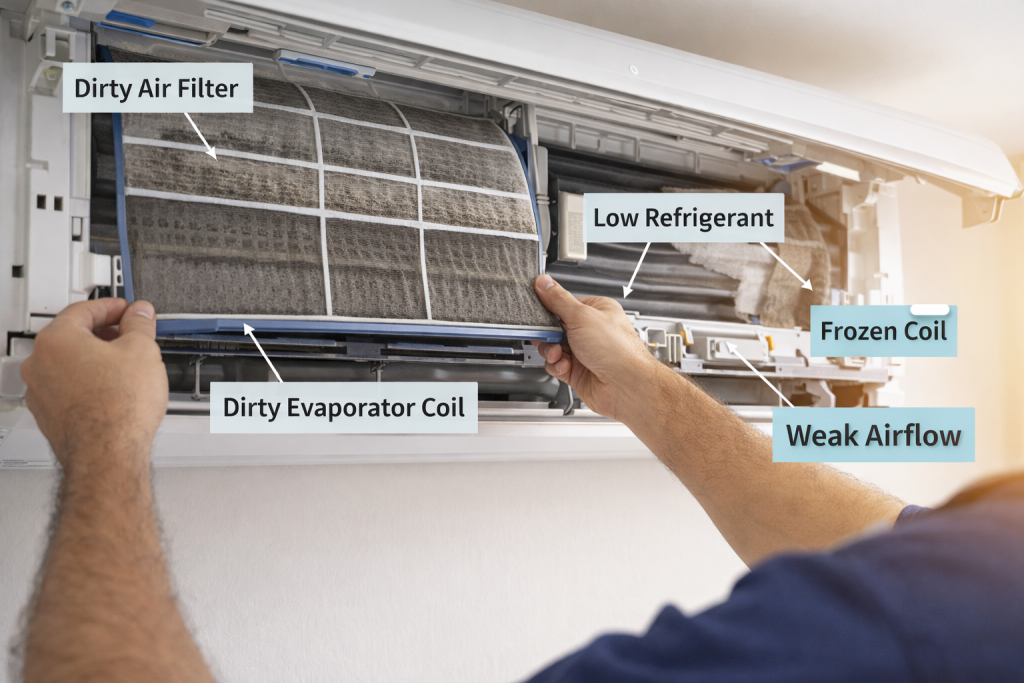
Why Your Air Conditioner Is Not Cooling Fast: 10 Common Reasons
When your air conditioner is running but the room still feels warm, it’s easy to assume the unit is “weak” or “broken.” In reality, slow cooling is usually caused by a small number of repeat issues: restricted airflow, poor heat exchange, refrigerant performance problems, incorrect controls, or a heat load the system was never sized to handle.
This guide explains what “not cooling fast” really means, why it matters, who is most affected, and how to troubleshoot the problem step by step. You’ll learn the 10 most common reasons an AC takes too long to cool, what you can safely do yourself, when to call a professional, and what to look for if you’re considering a replacement.
Key Takeaways
- Most “slow cooling” complaints are caused by airflow restriction, dirty coils, or outdoor heat rejection issues.
- Low refrigerant is not a normal “consumable.” If it’s low, a leak is likely and needs proper repair.
- Frozen evaporator coils usually indicate an airflow or refrigerant problem and should be addressed quickly.
- If your system can cool at night but struggles in the afternoon, heat gain (sun, insulation, air leaks) may be the real driver.
- Undersized BTU capacity leads to long runtimes and slow pull-down, even when the unit is working correctly.
- Fixing slow cooling early reduces energy bills, improves comfort, and protects expensive components like the compressor.
What Is “Air Conditioner Not Cooling Fast”?
“Not cooling fast” typically means one of three things: the room takes a long time to reach the set temperature, the supply air feels only mildly cool, or the system runs continuously without catching up. The key is to decide whether the behavior is normal for the conditions or a sign of performance loss.
On very hot or humid days, even a healthy system may need extra time to pull the temperature down—especially after the room has been heat-soaked. But if cooling speed has clearly worsened over weeks or months, or if comfort never stabilizes, the system likely has a measurable constraint.
Common signs it’s a real performance issue
- Weak airflow from vents or from the indoor unit louvers
- Air feels lukewarm even in cooling mode
- Indoor humidity stays high, with a sticky or clammy feel
- Ice or frost on indoor coil or refrigerant lines
- Outdoor unit seems unusually hot, noisy, or struggling to exhaust heat
- Electricity usage increases while comfort gets worse
If you want a quick refresher on how split systems move heat (and why airflow and coils matter so much), these primers are useful: Split Air Conditioner Explained: What It Is and How It Works and How Do Split Air Conditioners Work?.
Why It Matters / What Happened When Cooling Gets Slow
Slow cooling isn’t just a comfort complaint. It often signals that your system is operating under stress. When an air conditioner can’t cool fast, it typically runs longer cycles. Longer cycles raise energy consumption, increase operating temperatures and pressures, and accelerate wear on the compressor and electrical components.
There’s also a comfort and indoor-air angle. Systems that run inefficiently may struggle to remove moisture effectively, leaving rooms humid even when the temperature drops slightly. Over time, that can contribute to musty odors, condensation in certain areas, and more frequent filter and coil contamination.
What can happen if you ignore slow cooling
- Higher electricity bills due to extended runtime and lower system efficiency
- Humidity issues that feel uncomfortable and may increase odor and mold risk in vulnerable areas
- Greater breakdown risk, especially during peak heat when the system is already under maximum load
- Reduced lifespan of components such as capacitors, fan motors, and the compressor
Who Is Affected / Who Benefits From Fixing It
Anyone can experience slow cooling, but certain conditions make it more likely: top-floor spaces, rooms with strong afternoon sun, poorly insulated buildings, high-occupancy areas, and environments with frequent door opening (shops, small offices, cafés).
People who are heat-sensitive—children, older adults, and those with health considerations—benefit most from restoring fast, stable cooling. Business owners also benefit because consistent comfort impacts customer experience, dwell time, and staff productivity.
Who benefits from early action
- Homeowners: lower bills, better comfort, fewer emergency repairs
- Small businesses: improved customer experience and less downtime
- Property managers: fewer complaints, fewer repeat service calls
- Technicians and installers: cleaner diagnostics and fewer avoidable failures
10 Common Reasons Your Air Conditioner Is Not Cooling Fast
Use the list below to match symptoms to causes. Start with the simplest checks first. Many slow-cooling problems have a “root cause + secondary symptom” pattern—for example, a dirty filter leads to low airflow, which can lead to coil freezing, which then makes airflow even worse.
| What you notice | Likely causes | First action |
|---|---|---|
| Weak airflow | Dirty filter, blocked intake/return, blower issue, duct leakage | Replace/clean filter; clear obstructions |
| Air feels only slightly cool | Dirty coils, outdoor airflow restriction, low refrigerant, compressor weakness | Inspect coils and outdoor clearance |
| Ice on indoor coil/lines | Airflow restriction, low refrigerant, sensor/control issue | Stop cooling; thaw; check filter and vents |
| Works at night, struggles midday | High heat load, sun exposure, undersized BTU, dirty condenser | Reduce heat gain; check outdoor coil condition |
| Runs continuously, never reaches set temp | Undersized unit, major performance fault, extreme heat gain | Schedule a performance test and sizing review |
1) Dirty or Clogged Air Filter
A clogged filter is one of the most common reasons an air conditioner doesn’t cool fast. When the filter restricts airflow, the system can’t move enough warm air across the evaporator coil. Less air passing over the coil means less heat removed per minute, so cooling feels slow.
In many homes, a filter can look “not too bad” but still be restrictive enough to reduce airflow. If you’ve noticed weaker airflow, higher dust, or longer runtime, start here.
- What you’ll notice: weaker airflow, longer cycles, less consistent comfort.
- What to do: replace disposable filters or clean washable filters per the unit manual.
- What to watch for: if filters clog quickly, check for construction dust, pets, or poor return airflow.
2) Indoor Coil (Evaporator) Is Dirty
The evaporator coil absorbs heat from indoor air. Over time, fine dust can build on the coil surface, especially if filters aren’t changed consistently. That buildup acts like insulation and reduces heat transfer. Even if the unit is running normally, the coil can’t absorb heat as efficiently, so cooling slows down.
- What you’ll notice: air not as cold as before, humidity feels higher, sometimes a mild musty smell.
- What to do: schedule professional coil cleaning if performance doesn’t improve after filter replacement.
- Why it matters: dirty coils can lead to icing in high humidity or heavy load conditions.
3) Outdoor Coil (Condenser) Is Dirty or Blocked
The outdoor unit’s job is to reject heat to the outside. If the condenser coil is dirty or the unit is crowded by walls, plants, or stored items, heat can’t escape efficiently. This raises system pressures and reduces effective cooling capacity indoors.
Many “slow cooling” complaints get worse during midday because outdoor heat rejection becomes the bottleneck. A dirty condenser can be the difference between “keeps up” and “always behind.”
- What you’ll notice: cooling slows most in the afternoon; outdoor unit feels very hot; runtime increases.
- What to do: clear debris and keep proper clearance; consider professional cleaning for heavy buildup.
4) Low Refrigerant (Usually From a Leak)
Refrigerant is not a fuel. In a healthy sealed system, it circulates and should not gradually disappear. When refrigerant is low, it usually means there’s a leak. Low charge reduces the system’s ability to move heat, which directly slows cooling. It can also cause the evaporator coil to run too cold and freeze.
A common mistake is treating low refrigerant as something to “top off” without fixing the leak. That often results in repeat failures and higher lifetime cost.
- What you’ll notice: reduced cooling, possible ice, longer runtime, sometimes hissing.
- What to do: have a qualified technician find and repair the leak, then recharge to spec.
- What to watch for: recurring low charge points to an unresolved leak or poor repair quality.
5) Thermostat / Controller Settings or Sensor Placement
Sometimes the system is capable, but the controls are telling it to behave incorrectly. The most common issues are being in the wrong mode, using an unsuitable fan setting, or having a thermostat/sensor influenced by heat sources (direct sun, electronics, kitchen).
For split systems with a handheld remote, a simple mode mismatch (fan-only or dry mode instead of cool mode) can look exactly like slow cooling.
- What you’ll notice: inconsistent performance, short cycling, or low dehumidification.
- What to do: confirm “Cool” mode; set fan to “Auto” for balanced moisture control; avoid extreme setpoints.
6) Frozen Evaporator Coil
A frozen coil blocks airflow and dramatically reduces cooling speed. The freezing usually starts with a constraint—restricted airflow from a clogged filter, dirty coil surface, or low refrigerant. Once ice forms, airflow drops further, making the coil even colder.
If you see frost or ice, don’t keep forcing the system to run. Continuing can stress the compressor and lead to water leaks during thawing.
- What you’ll notice: ice/frost, very weak airflow, water after thawing.
- What to do now: turn off cooling; run fan-only to thaw; check filter and obstructions.
- When to call service: if icing returns, suspect refrigerant or blower issues.
7) Blower Fan Issues or Duct Problems (Ducted Systems)
For central or ducted systems, slow cooling often comes from poor air delivery rather than poor cooling generation. A blower motor can weaken, a fan wheel can get dirty, or ducts can leak into unconditioned spaces. Even a strong cold coil won’t help if the air can’t reach the rooms efficiently.
- What you’ll notice: uneven cooling, some rooms never catch up, airflow varies by register.
- What to do: open all registers; inspect visible duct connections; request airflow testing if issues persist.
8) Undersized AC (Wrong BTU for the Room)
If your air conditioner is undersized, it will cool slowly even when everything is clean and functioning. The system simply doesn’t have enough capacity to remove heat at the rate the room gains it. This is especially noticeable in peak heat and in rooms with sun exposure, high ceilings, or frequent door openings.
Sizing errors happen when equipment is selected by guesswork, or when the room’s usage changes over time (more people, more devices, more cooking, renovation that increases sun gain).
- What you’ll notice: runs nonstop, improves only at night, rarely reaches set temperature.
- What to do: request a load calculation for accurate sizing before replacing.
9) High Heat Load: Sunlight, Insulation, Air Leaks, and Indoor Heat Sources
Sometimes the AC is doing its job, but the building is fighting it. A room can gain heat faster than the system can remove it. Common contributors include direct sun through windows, poor insulation, air leakage, and internal heat sources such as cooking, lighting, and electronics.
This is why “slow cooling” often appears as a pattern: the room feels okay in the morning, then struggles in the afternoon. Improving the envelope can be as important as servicing the AC.
- What you’ll notice: hotter zones near windows; stronger struggle during peak sun hours.
- What to do: close curtains in peak sun, add shading, seal obvious gaps, reduce internal heat when possible.
10) Electrical or Mechanical Component Weakness (Capacitor, Compressor, Fan Motor, Sensor)
Systems can lose cooling speed without fully failing. A weakening capacitor can make starts harder, a fan motor can run below optimal speed, a sensor can misread temperature, or the compressor can lose efficiency over time. The unit still runs, but capacity drops.
These issues often become visible as “it used to cool fast, now it doesn’t.” If basic cleaning and settings checks don’t help, professional diagnostics are the next step.
- What you’ll notice: unusual sounds, short cycling, inconsistent cooling, occasional tripping.
- What to do: stop repeated restarts; schedule professional inspection.
What to Do / How to Troubleshoot Step by Step
The most effective troubleshooting approach is to move from high-probability, low-risk checks to deeper diagnostics. This avoids unnecessary parts replacement and prevents misdiagnosis.
Step 1: Confirm the basics
- Set to Cool mode and confirm the target temperature is realistic.
- Set the fan to Auto for balanced comfort and humidity control.
- Make sure indoor intake/return is not blocked by curtains, furniture, or storage.
- Open vents/registers; avoid closing too many rooms off in ducted systems.
Step 2: Fix airflow constraints
- Replace or clean the air filter.
- Check for visible dust buildup at the indoor unit intake.
- If airflow remains weak, consider blower or coil inspection by a professional.
Step 3: Inspect outdoor performance
- Clear debris around the outdoor unit and ensure proper clearance.
- Look for heavy dirt on the coil surface (do not bend fins).
- If the outdoor fan is not running consistently, stop the system and call service.
Step 4: Respond correctly to icing
- If you see ice, turn off cooling immediately.
- Run fan-only mode to thaw the coil.
- After thawing, address filter/airflow issues before restarting cooling.
- If icing returns, schedule refrigerant and airflow diagnostics.
Step 5: Confirm sizing and heat load
If everything is clean, airflow is strong, and the system still cools slowly—especially in a specific room— look at sizing and heat load. A professional load calculation is the most reliable method. It accounts for room volume, insulation, sun exposure, windows, occupancy, and internal heat sources.
Pros and Cons: DIY Fixes vs Professional Service
DIY actions
- Pros: low cost, immediate improvement, reduces wasted runtime, helps prevent avoidable failures.
- Cons: limited scope; improper coil cleaning can damage fins or sensors; cannot address refrigerant leaks safely.
Professional service
- Pros: accurate diagnostics, leak repair, proper charging, electrical testing, airflow measurement.
- Cons: service cost; quality depends on technician; avoid replacement recommendations without test data.
| Task | DIY | Professional recommended |
|---|---|---|
| Replace/clean filter | Yes | No |
| Clear outdoor debris and improve clearance | Yes | No |
| Deep indoor coil cleaning | Limited | Yes |
| Refrigerant leak repair and recharge | No | Yes |
| Capacitor, compressor, fan motor testing | No | Yes |
| Load calculation and sizing verification | No | Yes |
Examples / Case Studies: What Fixed Slow Cooling in Real Situations
Case Study 1: “It runs all day but the room never cools down”
A homeowner reported that their split AC ran continuously but still struggled in the afternoon. Basic checks showed the filter was acceptable, but the room had strong sun exposure through large glass areas. Curtains stayed open and the room heat-soaked daily.
The fix combined building and equipment improvements: adding shading during peak sun hours and cleaning a dust-loaded outdoor coil. After that, the system reached the set temperature faster and cycled more normally.
Case Study 2: “Cooling feels weaker and humidity is higher than before”
A small office noticed slow pull-down and a sticky feel. Airflow was weaker than usual. The filter was overdue for replacement and the indoor coil had fine buildup.
Replacing the filter and scheduling professional evaporator cleaning restored airflow. Comfort improved, and the space felt drier without needing an aggressive temperature setting.
Case Study 3: “Ice on the indoor unit, then water dripping later”
Another user saw frost on the indoor coil followed by water when the ice melted. Thawing helped temporarily, but icing returned quickly.
Service inspection confirmed low refrigerant due to a leak at a connection point. Once repaired and charged to specification, the unit regained normal cooling speed and icing stopped.
Impacts on Industry / Customers / Environment
Slow cooling increases runtime, which increases energy consumption. From a customer standpoint, it often triggers unnecessary replacements when the real issue is maintenance or a straightforward repair. From an industry standpoint, it can drive repeat service calls if the root cause is not identified.
There’s also an environmental dimension. Efficient systems reduce electricity demand. And if slow cooling is linked to refrigerant leakage, fixing the leak matters both for performance and environmental responsibility.
If you’re exploring modern system options that support smoother comfort and potentially better part-load efficiency, this overview can help: Understanding the Mini Split Inverter Air Conditioner.
What to Look for in a Fast-Cooling Air Conditioner
If your current unit is aging, undersized, or repeatedly needs refrigerant service, replacement may be more cost-effective. The goal isn’t simply “more BTU.” It’s the right capacity for the load, reliable airflow delivery, and efficient heat exchange.
Fast-cooling selection checklist
- Correct BTU sizing: based on room size, ceiling height, sun exposure, insulation, and occupancy.
- Inverter vs non-inverter: inverter systems can maintain stable comfort under changing load; non-inverter systems may prioritize upfront cost.
- Airflow and louver control: strong airflow and adjustable swing can reduce hot spots and speed comfort recovery.
- Noise performance: quieter indoor operation improves sleep and daily comfort.
- Serviceability: easy filter access and dependable after-sales support reduce long-term hassle.
Comparison: inverter vs non-inverter (cooling speed and comfort)
Cooling speed depends on both capacity and control. In many real homes, the ability to modulate output smoothly matters. Inverter systems often keep the temperature steadier once the room is close to the setpoint, which can feel more comfortable overall. Non-inverter units can feel more “on/off,” which may be fine in certain use cases.
- Inverter pros: stable temperature, strong comfort recovery, often quieter and more efficient at partial load.
- Inverter cons: higher upfront cost; correct installation quality is essential for best performance.
- Non-inverter pros: lower initial cost; simpler control system.
- Non-inverter cons: less stable comfort; may consume more power under frequent cycling.
If you want a broader decision guide for split systems, this page is a good internal reference point: Best Split Unit Air Conditioner: A Complete Buying Guide.
For users comparing system formats, this can help reduce confusion about trade-offs: Split Air Conditioner vs Window: A Complete Comparison Guide.
If you want a product browsing hub to link readers into model options, you can add a contextual link like: Inverter Split Air Conditioner Category.
Conclusion
When your air conditioner is not cooling fast, the fix is usually not mysterious. Start with airflow: replace the filter, clear obstructions, and confirm settings. Then check heat exchange: indoor coil condition and outdoor unit clearance. If you see icing, treat it as a warning sign and address airflow and refrigerant factors before continuing normal operation.
If slow cooling persists after basic cleaning and correct settings, it’s time for professional diagnostics—especially to rule out refrigerant leaks, electrical component weakness, or sizing problems. The sooner you identify the root cause, the more likely you are to restore fast cooling with a lower total cost and less wear on the system.
FAQ
Why does my AC take so long to cool the room?
The most common causes are restricted airflow (dirty filter, blocked intake/return), dirty coils, outdoor airflow restriction, and high heat gain from sun and air leaks. If the unit used to cool faster, refrigerant leakage or a weakening component may also be involved.
Should I set the thermostat much lower to make the AC cool faster?
Lowering the setpoint typically makes the system run longer rather than making it cool faster in a meaningful way. You’ll get better results by improving airflow, keeping coils clean, and reducing heat gain (shading windows, sealing gaps).
Can low refrigerant cause weak cooling even if the AC is still running?
Yes. Low refrigerant reduces the system’s ability to move heat and can lead to coil freezing. Because refrigerant should not “run out” in a sealed system, low charge usually points to a leak that should be repaired properly.
Why is my split air conditioner blowing air but not cooling fast?
Common reasons include dirty filters, dirty indoor coils, restricted outdoor airflow, incorrect mode settings, or refrigerant issues. If airflow is strong but the air isn’t cold, a professional performance check is recommended.
What’s the fastest safe DIY fix to improve AC cooling performance?
Replace or clean the filter, clear intake/return obstructions, ensure the outdoor unit has good clearance, and reduce heat gain by shading windows. If you see ice, stop cooling and thaw the coil before restarting.
How do I know if my AC is undersized?
If the system runs constantly, cools slowly during peak heat, and rarely reaches the set temperature despite clean filters and coils, it may be undersized or the room heat load may be too high. A load calculation is the best way to confirm.