

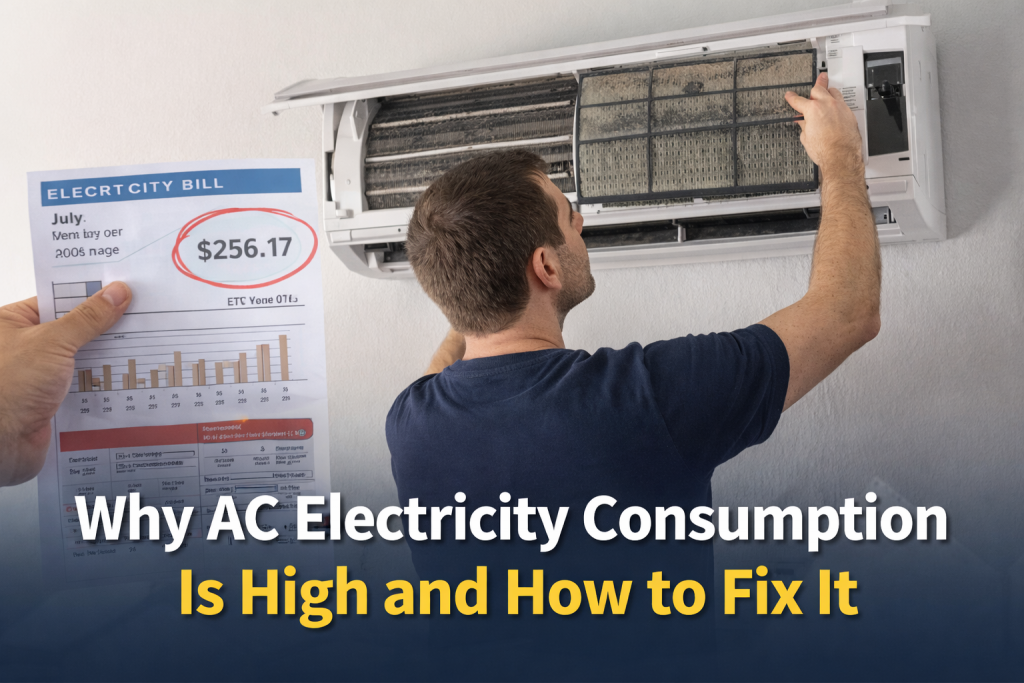
If your electricity bill has climbed and nothing else in your household changed, your air conditioner is a logical place to look. AC systems are among the highest-energy appliances in most homes and small businesses. When something reduces efficiency, the unit doesn’t always “break.” It simply runs longer, works harder, and quietly burns more power to deliver the same comfort.
The good news is that high AC electricity consumption is usually explainable and fixable. In many cases, the solution is not a new unit. It’s correcting airflow issues, cleaning heat-exchange surfaces, adjusting settings, improving the space’s heat load, or confirming the AC is sized correctly. This guide walks you through the most common causes and a practical plan to reduce AC power consumption without sacrificing comfort.
Key Takeaways
- High AC electricity consumption is typically caused by longer runtime: the system needs more time to remove the same heat.
- Airflow restrictions (dirty filters, blocked vents, weak fans) and dirty coils are top drivers of wasted energy.
- Thermostat habits, fan mode, and temperature setpoints can increase consumption more than most people expect.
- Incorrect AC sizing (especially undersizing) causes nonstop operation and higher monthly bills.
- Inverter systems often reduce electricity use by matching output to demand instead of frequent on/off cycling.
- Improving building heat load (sun, insulation, air leaks) can cut consumption even if you keep the same AC.
What Is AC Electricity Consumption?
AC electricity consumption is the amount of electrical energy your air conditioner uses during operation, typically measured in kilowatt-hours (kWh). Your bill is based on how many kWh you consume, multiplied by your local electricity rate, plus any fees and taxes.
From a practical standpoint, AC electricity consumption is mainly driven by two things: how much power the system draws when running, and how long it runs each day. Most “high consumption” situations happen because runtime increases. The unit might be drawing normal power, but it runs for many more hours to maintain temperature.
If you want a deeper, calculation-focused explanation for split systems (including kWh estimation logic), this internal guide is a strong companion read: Split Air Conditioner Electricity Consumption: A Complete Guide .
How an air conditioner uses electricity
Most of the electricity in an AC system is used by the compressor (the component that drives the refrigeration cycle), plus the fans that move air across the indoor and outdoor coils. Electronics, sensors, and control boards draw comparatively less, but they influence how efficiently the system operates.
Why It Matters / What Happened When Consumption Spikes
High electricity consumption isn’t just a cost issue. It’s often an early warning sign that the system is operating under stress. Extended runtime increases wear on the compressor, raises operating temperatures, and can accelerate failures in capacitors, motors, and control components.
It also affects comfort. A system that runs inefficiently may struggle to manage humidity, leaving the space clammy even when the temperature drops. That often leads to a common cycle: occupants lower the thermostat further, which increases runtime and pushes consumption even higher.
Common “bill shock” patterns
- Seasonal shift: outdoor temperatures rise and the AC begins running longer each day.
- Hidden efficiency loss: filters and coils gradually dirty, reducing heat transfer.
- Behavior changes: more people at home, longer hours, or doors/windows opened frequently.
- Space changes: a new room layout blocks airflow, or added equipment increases indoor heat load.
High consumption can be normal during extreme heat. The key is to identify whether the increase is proportional to conditions, or whether efficiency has dropped compared to previous seasons under similar weather and usage.
Who Is Affected / Who Benefits Most From Fixing It
Anyone using AC can experience high power consumption, but certain environments and usage profiles make it far more likely. Top-floor apartments, sun-facing rooms with large windows, humid coastal climates, and small shops with frequent door openings all create higher cooling loads.
Most affected groups
- Households in hot or humid regions where AC runs many hours per day.
- Small businesses where comfort impacts customer dwell time and staff productivity.
- Property managers handling tenant complaints and maintenance budgeting.
- Families with heat-sensitive occupants who need stable comfort and safe indoor temperatures.
Who benefits from fixing high consumption early
- Owners: lower bills and longer equipment life.
- Tenants: improved comfort without needing extreme thermostat settings.
- Facilities teams: fewer breakdowns during peak season, fewer emergency service calls.
Why Your AC Electricity Consumption Is High: The Most Common Causes
High electricity consumption is rarely a single issue. It’s usually a combination of reduced efficiency and increased heat load. The list below reflects the most common causes found in real troubleshooting: they appear again and again across homes, offices, and retail spaces.
1) Dirty or clogged air filter
A dirty filter restricts airflow. When airflow drops, the system removes less heat per minute, so it has to run longer. Longer runtime is the most direct path to higher electricity usage.
- What you’ll notice: weaker airflow, rooms taking longer to cool, rising bills.
- Fix: replace disposable filters or wash reusable filters on schedule.
2) Dirty indoor coil (evaporator coil)
The indoor coil absorbs heat from your room air. If coil fins are coated with dust or buildup, heat transfer declines. The unit still runs, but it produces less effective cooling per hour of electricity consumed.
- What you’ll notice: reduced cooling, higher humidity feel, longer cycles.
- Fix: professional coil cleaning if filter changes don’t restore performance.
3) Dirty outdoor coil or restricted outdoor airflow
The outdoor unit must release heat efficiently. When the condenser is dirty or airflow is blocked, the system operates at higher pressures, which can increase power draw and reduce capacity. This often shows up as “everything was fine, then bills got worse in hot afternoons.”
- What you’ll notice: more runtime during midday heat, outdoor unit feels excessively hot.
- Fix: clear debris, keep proper clearance, and consider professional cleaning when buildup is heavy.
4) Incorrect thermostat settings and habits
Thermostat behavior has a bigger effect on electricity consumption than most people realize. Very low setpoints can create long run cycles, and “Fan On” mode can increase fan runtime without improving comfort.
- What you’ll notice: system seems to run constantly; bills rise without a clear mechanical fault.
- Fix: set a realistic temperature, use “Auto” fan mode, and avoid frequent setpoint changes.
5) Poor insulation, air leaks, and high heat gain
Your AC can only remove heat; it cannot stop heat from entering the space. Sun through windows, gaps around doors, poor insulation, and heat from appliances can push cooling load beyond what the system can efficiently handle. The result is higher AC electricity usage even when the unit is functioning correctly.
- What you’ll notice: rooms near windows are hotter; midday performance drops; runtime rises.
- Fix: shading, sealing leaks, improving insulation, and reducing internal heat sources when possible.
6) Incorrect AC sizing (especially undersized capacity)
If an air conditioner is undersized, it must run for long periods to maintain temperature. That long runtime drives high electricity consumption even if the unit is “efficient” on paper.
- What you’ll notice: constant operation, slow comfort recovery after door openings, setpoint rarely reached.
- Fix: get a proper load calculation before deciding on repair vs replacement.
7) Low refrigerant charge or refrigerant leaks
Low refrigerant can reduce cooling capacity and cause the system to run longer. If the charge is low, there is often a leak that needs proper repair. Continued operation under abnormal conditions can also increase mechanical stress.
- What you’ll notice: weak cooling, longer cycles, sometimes ice on indoor lines/coil.
- Fix: professional leak detection and correct recharging to specification.
8) Aging components: capacitors, motors, sensors, and compressor efficiency loss
Systems can lose performance without a single dramatic failure. A weakening capacitor can reduce motor performance, a fan may run below optimal speed, or sensors may misread temperature and drive inefficient cycling. The unit keeps running, but electricity consumption increases.
- What you’ll notice: inconsistent comfort, unusual noises, higher bills over time.
- Fix: professional inspection and measured diagnostics, not guesswork replacements.
9) Duct losses and airflow imbalance (ducted systems)
In ducted systems, leaks and poor balancing can waste conditioned air before it reaches occupied rooms. That forces the thermostat to call for cooling longer, driving higher power use.
- What you’ll notice: some rooms are always warmer; the system runs longer to satisfy the thermostat location.
- Fix: duct inspection, sealing, and airflow balancing by a qualified technician.
10) Wrong system type for the use case
Sometimes electricity consumption is high because the system design does not match how the space is used. For example, cooling one room intermittently may be more efficient with a ductless mini split than with a whole-home central system, depending on layout and usage patterns.
If you are comparing system formats, this internal comparison guide can help you evaluate trade-offs: Split Air Conditioner vs Window: A Complete Comparison Guide .
What to Do / How to Fix High AC Electricity Consumption
The most cost-effective approach is a staged plan: fix the easy, high-probability issues first, then escalate to professional checks only when data suggests it’s necessary. This avoids unnecessary part swaps and reduces the risk of misdiagnosis.
Step-by-step plan: reduce AC power consumption in the next 7 days
Step 1: Restore airflow (Day 1)
- Replace or clean the air filter.
- Make sure return vents and supply vents are not blocked by furniture, curtains, or storage.
- Set fan mode to “Auto” (not “On”) unless your local conditions require continuous air circulation for a specific reason.
Step 2: Improve heat rejection (Day 2–3)
- Clear debris and ensure outdoor unit clearance for airflow.
- Check that outdoor exhaust air is not recirculating due to tight enclosure.
- If the unit is visibly dirty, schedule professional condenser cleaning.
Step 3: Reduce building heat load (Day 3–5)
- Close curtains or blinds during peak sun hours, especially on west-facing windows.
- Seal obvious gaps around doors and windows.
- Limit internal heat sources in peak hours when feasible (heavy cooking, high-heat appliances).
Step 4: Adjust operating strategy (Day 5–7)
- Avoid rapid setpoint swings. Consistent settings often reduce inefficient cycling.
- Use sleep mode or scheduled setpoints when rooms are unoccupied.
- If humidity is the main discomfort driver, focus on stable operation instead of extreme low temperature settings.
When to call a professional
If your filter is clean, airflow is strong, the outdoor unit has clearance, and the system still runs excessively, the next step is professional diagnostics. This should include measured temperature performance, refrigerant checks, fan operation verification, and confirmation that the system is correctly sized for the load.
Product Comparison Table: Which AC Type Typically Uses Less Electricity?
The most efficient option depends on your space size, how many rooms you cool, and how often you operate the system. The table below reflects typical real-world positioning rather than best-case marketing conditions.
| System Type | Typical Electricity Use Profile | Best For | Common Consumption Traps |
|---|---|---|---|
| Inverter Mini Split (Ductless) | Often lower consumption due to variable-speed operation and zoning | Homes/shops cooling specific rooms for long periods | Undersizing, dirty coils, poor installation quality |
| Non-Inverter Split | Can be higher due to on/off cycling, especially with frequent setpoint changes | Budget installations with simpler control needs | Short cycling, aggressive thermostat habits |
| Window AC | Varies widely; can be higher for similar comfort in larger rooms | Small rooms, temporary setups | Air leakage around installation, noise leads to suboptimal use |
| Central/Ducted AC | Can be efficient for whole-home cooling; losses can rise with duct leakage or imbalance | Whole-home comfort with consistent use | Duct leaks, cooling unoccupied rooms, poor zoning |
If you want a clear explanation of inverter behavior and why it can reduce electricity usage under partial load, this internal article is a useful companion: Understanding the Mini Split Inverter Air Conditioner .
Pros and Cons: The Most Common Fix Paths
Low-cost fixes (filters, airflow, settings)
- Pros: immediate impact, low risk, often solves the majority of high-consumption complaints.
- Cons: will not fix refrigerant leaks, failing components, or incorrect sizing.
Maintenance-focused fixes (coil cleaning, outdoor clearance, system tune-up)
- Pros: restores heat transfer efficiency, improves comfort, and reduces runtime.
- Cons: requires qualified service when buildup is heavy; poor cleaning can damage coils or sensors.
Repair-focused fixes (refrigerant leak, motor/capacitor replacement, sensor correction)
- Pros: addresses true efficiency losses that cannot be solved by cleaning or habits.
- Cons: quality varies by technician; “top-off” refrigerant without leak repair often leads to repeat costs.
Replacement-focused fixes (upgrading system type or efficiency level)
- Pros: can reduce long-term consumption significantly when the old system is mismatched or near end-of-life.
- Cons: higher upfront cost; savings depend on correct sizing and installation quality.
Best Split Unit Air Conditioner: A Complete 2025 Buying Guide and Shop Mini Split Air Conditioners: A Complete Buying Guide for 2025 .
Examples / Case Studies: How People Reduced High AC Electricity Consumption
Case Study 1: The “clean-looking filter” that still caused high bills
A household saw a monthly bill increase even though the AC seemed to cool normally. Airflow felt slightly weaker, but the filter did not look heavily clogged. After replacing the filter and clearing a partially blocked return path behind furniture, airflow improved. The system reached set temperature faster and cycled less.
Outcome: lower runtime and noticeable bill improvement over the next billing cycle.
Case Study 2: Midday bill spikes caused by outdoor unit heat rejection problems
A small shop experienced strong cooling in the morning, then weak cooling and higher consumption in the afternoon. The outdoor unit had limited clearance and a dirty condenser surface. After improving clearance and scheduling a proper outdoor coil cleaning, performance stabilized during peak heat.
Outcome: improved midday comfort and reduced power usage due to shorter run cycles.
Case Study 3: Undersized capacity led to nonstop operation
A renovated room added more occupants and equipment heat, but the AC capacity remained unchanged. The unit ran for long periods and still struggled to hold set temperature during busy hours. A load review showed the system was undersized for the new conditions. The upgrade to a properly sized, inverter-based solution improved comfort stability and reduced wasteful runtime.
Outcome: lower electricity consumption for the same comfort level, plus fewer comfort complaints.
Impacts on Customers, Industry, and the Environment
From a customer perspective, high AC electricity consumption is often treated as an unavoidable seasonal cost. In reality, many causes are preventable with routine maintenance and better operating strategy. For small businesses, reducing AC energy use can meaningfully improve margins over time.
From an industry perspective, the largest service pain points often come from delayed maintenance: dirty coils, restricted airflow, and chronic overscheduling of systems beyond their intended load. These issues increase breakdown rates and shorten equipment life.
Environmentally, reducing wasted runtime reduces electricity demand and the upstream emissions associated with power generation. If high consumption is linked to refrigerant leaks, repairing leaks matters both for performance and responsible operation.
What to Look for in an Energy-Efficient Air Conditioner
If you’ve already fixed airflow, cleaned coils, and improved heat load—but electricity consumption is still high— replacement may be the most economical long-term decision. The goal is not “more power.” It is the right match between capacity, control technology, and your real usage pattern.
Checklist for choosing a lower-consumption AC
- Correct sizing: choose capacity based on a load calculation, not only room area.
- Inverter technology: variable-speed operation can reduce energy waste caused by frequent cycling.
- Room-by-room control: zoning reduces wasted cooling of unoccupied spaces.
- Noise and comfort stability: stable operation often reduces the need for extreme thermostat settings.
- Installation quality: line set, drainage, outdoor placement, and commissioning strongly affect real efficiency.
- Maintenance access: easy filter access and service-friendly design supports long-term performance.
Inverter vs non-inverter: a practical comparison
Many buyers focus on rated efficiency, but real-world consumption depends on control behavior. Inverter systems adjust output to match demand, which can reduce energy waste in typical daily use. Non-inverter systems often rely on on/off cycling, which can be less efficient under frequent temperature changes.
- Inverter pros: stable comfort, efficient partial-load operation, often quieter day-to-day performance.
- Inverter cons: higher upfront cost; performance depends on correct sizing and installation.
- Non-inverter pros: lower initial cost; straightforward control approach.
- Non-inverter cons: can consume more electricity in stop-start patterns and fluctuating loads.
Best Split Air Conditioner Brand: 2025 Buying Guide and Mini Split Air Conditioner and Heat: A Complete Guide .
Conclusion
When AC electricity consumption is high, the root cause is usually extended runtime driven by reduced efficiency or increased heat load. Start with the basics: clean filters, restore airflow, improve outdoor clearance, and stabilize thermostat habits. Then address the space itself through shading, air sealing, and insulation where practical.
If the system still runs excessively after these steps, move to measured diagnostics: check coil condition, refrigerant performance, fan operation, and whether the unit is correctly sized for the load. In many cases, a well-sized inverter system and better operating strategy can deliver the same comfort with less wasted electricity.
FAQ
Why is my AC electricity bill so high all of a sudden?
The most common reasons are longer runtime due to hotter weather, a dirty filter or coils, restricted outdoor airflow, or a change in household behavior. If bills jumped without a clear seasonal change, check airflow and maintenance first, then consider professional diagnostics.
Does setting the temperature lower make the AC use more electricity?
It often increases electricity use because it forces longer runtime to reach a lower setpoint. A stable, realistic temperature setting typically reduces inefficient cycling and helps control consumption.
Is inverter AC always cheaper to run than non-inverter?
Many users see lower electricity consumption with inverter systems because output adjusts to demand instead of frequent on/off cycles. However, real savings depend on proper sizing, installation quality, and how consistently you operate the unit.
How can I reduce AC electricity consumption without replacing my air conditioner?
Replace or clean filters, ensure vents are not blocked, clean coils when needed, improve outdoor unit airflow, reduce heat gain with shading and air sealing, and avoid extreme setpoint changes. These steps often deliver meaningful reductions.
Why does my AC run all day and still use a lot of electricity?
Continuous operation can be caused by undersized capacity, high heat gain (sun, air leaks), dirty coils, airflow restriction, or refrigerant-related performance loss. If basic maintenance does not help, a load calculation and measured diagnostics are recommended.
What is the best temperature setting to save electricity on AC?
The best setting depends on comfort needs and humidity conditions, but in general, a stable, moderate setpoint is more efficient than frequent large changes. Pairing a reasonable setpoint with good airflow and reduced heat gain typically yields the best savings.