

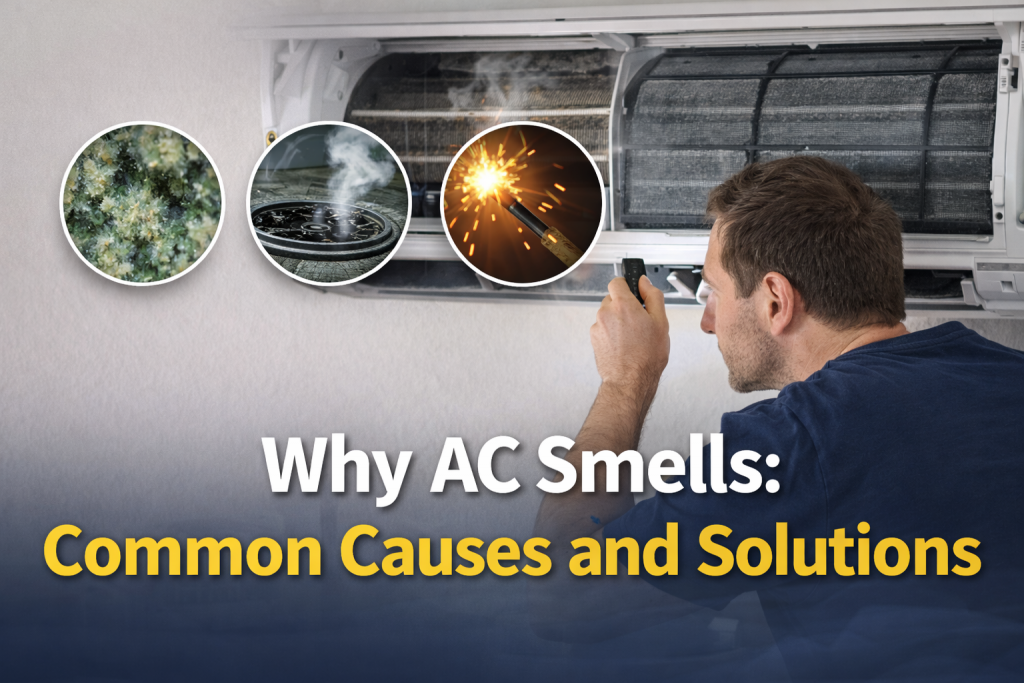
An air conditioner should make a room feel cleaner and more comfortable—not fill it with a musty, sour, or “something’s wrong” odor.
When an AC smells, it’s usually not a mystery scent. It’s a clue.
Most AC odors come from three places: moisture that’s not draining correctly, dirt buildup that becomes a food source for microbes,
or a heat/electrical issue that needs attention. Some smells are minor maintenance problems. Others can be urgent.
This guide explains why your AC smells, what different odors typically mean, and how to fix the root cause—not just cover it up.
It’s written for homeowners, tenants, and small business operators who want clear steps and safe decision-making.
Key Takeaways
- Musty or “wet sock” AC smells usually point to moisture + microbial growth on coils, filters, or in the drain system.
- Sewage-like odors often involve drain line issues, dry traps, or contamination near the condensate route.
- Burning smells can indicate dust burn-off, motor issues, wiring problems, or overheating components—treat persistent burning odors as urgent.
- Chemical or sweet smells may be related to refrigerant or plastics overheating; don’t ignore strong, unusual chemical odors.
- Many AC smell problems are fixable with correct cleaning and drainage checks, but repeated odors usually require deeper service.
- Long-term prevention is about airflow, dry coils, proper drainage, and consistent maintenance—not fragrance sprays.
What Is “AC Smell” and Where Does It Come From?
“AC smell” is any odor you notice when the air conditioner starts or runs—especially when it’s localized to the supply airflow.
Odors are carried by the same air your system circulates. That means the smell source is typically inside the indoor unit,
in the condensate drainage path, or in the ductwork (for ducted systems).
In a split system, humid indoor air passes across the cold evaporator coil. Moisture condenses, and the condensate should drain away.
When dirt and moisture combine, they can create a biofilm—an ideal environment for mold and bacteria—leading to musty or sour smells.
If you want a practical walkthrough of what gets dirty inside a mini split and how cleaning is typically performed,
see this related guide:
Cleaning a Mini Split Air Conditioner: A Complete Guide
.
Why odors show up most at startup
Many people notice smells right when the AC turns on. That’s because microbial odors often build when the unit is off and damp,
then get pushed into the room when the fan starts. Odors can also be stronger during high humidity seasons, when condensation increases.
The three most common odor zones
- Airflow path: filters, coil fins, blower wheel, louvers, and internal plastic surfaces.
- Condensate path: drain pan, drain hose, drain line route, and nearby traps.
- Outdoor/electrical zone: wiring, motors, PCB/control boards, overheated insulation, or debris near the outdoor unit.
Why It Matters / What Happened When Your AC Starts Smelling
An unpleasant smell is not only an annoyance. It can signal reduced indoor air quality and, in some cases, a safety risk.
For example, persistent burning smells may indicate overheating components. Sewage smells can indicate biological contamination.
Odors also correlate with performance problems. A dirty coil and blower wheel reduce airflow and heat transfer.
That can lead to longer runtime, less effective cooling, and higher electricity use.
Smell problems and efficiency problems often share the same root cause: buildup in the indoor unit.
When an AC smell is an urgent problem
Use this “stop-and-check” rule. If you smell any of the following, turn the system off and investigate immediately:
- Burning plastic, electrical, or “hot wire” smell: could be wiring, motor, or board overheating.
- Strong chemical smell with irritation: treat as potentially harmful; ventilate and seek service.
- Rotten egg smell: can be associated with gas issues in some environments (not typically produced by AC itself).
- Visible smoke, sparking, or tripping breakers: stop using the unit and contact qualified service.
When it’s typically a maintenance issue
Musty, sour, “wet sock,” and mild mildew smells are most commonly maintenance-related.
These are often solvable with correct cleaning, drying strategies, and drain system checks.
Who Is Affected / Who Benefits From Fixing It
Anyone can experience AC odors, but certain environments and habits make smells far more likely.
High humidity, frequent on/off cycling, long periods of fan-only operation, and spaces with high dust or cooking grease
accelerate buildup inside the indoor unit.
Most affected groups
- Homes in humid climates: more condensation and slower drying inside the unit.
- Bedrooms and nurseries: odor sensitivity is higher and comfort expectations are stricter.
- Small shops and cafes: frequent door opening, higher airborne particles, and more odor sources indoors.
- Allergy-sensitive occupants: microbial odors can worsen perceived air quality.
Who benefits most from early action
- Owners: fewer repeat service calls and better long-term reliability.
- Tenants: improved comfort without needing to “mask” odors.
- Facilities teams: less downtime during peak season and fewer odor complaints.
Common AC Smells and What They Usually Mean
Different smells tend to point to different root causes. The goal is not to diagnose by odor alone,
but to use odor as a starting clue and confirm with simple checks.
Musty or mildew smell (“wet sock” smell)
This is the most common AC odor. It typically indicates moisture lingering on dirty surfaces—filters, evaporator coils, or the blower wheel.
Microbes feed on dust and organic particles, creating a persistent musty smell.
- Likely causes: dirty coil, dirty blower wheel, wet drain pan, blocked drain line, high indoor humidity.
- Quick check: inspect filters and look for dampness or visible buildup behind the front panel.
Sour, “gym bag,” or vinegar-like odor
Sour odors often indicate bacterial growth in a wet environment—especially around the drain pan and condensate route.
In some cases, it’s a sign of biofilm and stagnant water.
- Likely causes: dirty drain pan, slime in drain hose, standing condensate, contaminated drain route.
- Quick check: look for water stains, dripping, or gurgling from the drain line.
Sewage smell
Sewage-like odors usually involve the condensate drainage path interacting with a contaminated area, a dry trap, or a poor drain route.
In ducted systems, odors can also enter through duct leakage or negative pressure pulling air from undesired zones.
- Likely causes: drain line routing issues, dry trap, nearby contamination, duct leakage (ducted systems).
- What to do: verify drainage route and consider professional assessment if the smell is strong or persistent.
Burning dust smell (brief, mild)
A mild “burning dust” smell for a short time can happen at the start of a season, especially if the system hasn’t run for months.
Dust on warm components can burn off briefly.
- Normal if: it lasts only a few minutes and does not return.
- Not normal if: it persists, intensifies, or comes with noise, smoke, or breaker trips.
Burning plastic or electrical smell (persistent)
Treat this as urgent. It may involve overheating wiring, capacitors, motors, or control components.
Continued operation risks damage or safety issues.
- What to do: turn off the unit, ventilate, and contact qualified service.
Chemical smell (sharp, sweet, or “solvent-like”)
Chemical odors can be associated with overheated plastics, adhesives, or, in rare cases, refrigerant-related issues.
Even if the unit seems to cool, strong chemical smells should be taken seriously.
- What to do: stop using the unit if the odor is strong, irritating, or persistent; seek service.
Dead animal or rotten odor
This can occur if a small animal enters ductwork (ducted systems) or if debris becomes trapped and decomposes near airflow paths.
It’s less common in typical wall-mounted mini splits, but not impossible in some environments.
- What to do: locate the source; professional support may be needed for safe removal and sanitization.
What to Do / How to Fix AC Smells (Step-by-Step)
The most effective approach is staged: handle the high-probability maintenance items first,
then escalate to deeper cleaning or professional diagnostics if the odor returns.
Cover-up solutions (sprays, fragrances) usually worsen the underlying microbial issue over time.
Step 1: Identify the odor pattern
- Only at startup: damp internal surfaces or microbial growth is likely.
- Only when cooling: condensate-related issues are more likely.
- Only when heating: dust burn-off or electrical heating components may be involved (if applicable).
- All the time: consider drain contamination, duct issues, or persistent internal buildup.
Step 2: Clean or replace the filters
Filters are the easiest and fastest improvement. Dirty filters also contribute to higher humidity feel and longer runtime.
Clean reusable filters fully and let them dry completely before reinstalling.
Step 3: Inspect the indoor unit for visible buildup
Open the front panel and inspect the coil fins and internal surfaces.
If you see dark buildup, greasy dust, or signs of damp residue, a deeper clean is likely needed.
A practical reference for the cleaning workflow is here:
Cleaning a Mini Split Air Conditioner: A Complete Guide
.
Step 4: Check the drain pan and drain line for clogs
Many odors are “drain problems in disguise.” If water is not draining properly, odor-causing microbes thrive.
Look for dripping, gurgling, or water stains. If accessible, clear minor clogs safely or use professional help for stubborn blockages.
Drain line and condensate routing are also closely tied to installation quality.
If you suspect routing issues, this installation overview may help you understand what’s normal in split systems:
How to Install a Split Unit Air Conditioner: Step-by-Step Guide
.
Step 5: Dry the unit properly after heavy use (when appropriate)
In humid seasons, moisture can linger on the coil and blower wheel. Some systems have a drying or self-cleaning mode.
If your unit supports it, use it consistently. If not, running the fan briefly after cooling can help drying in some environments,
but it’s not a substitute for cleaning if there’s established biofilm.
Step 6: If odor persists, plan a deep clean or professional service
Persistent odors often mean the blower wheel and coil area have buildup beyond what filter cleaning can solve.
Deep cleaning typically targets the evaporator coil, blower wheel, drain pan, and internal plastic surfaces.
If you have a ducted system, duct inspection may also be needed.
Product Comparison Table: Options That Help Reduce AC Odors
Not every odor problem needs a “product.” Many are solved by cleaning and fixing drainage.
But some tools and solutions can help depending on the root cause.
The table below compares common options and when they make sense.
| Option | Best For | Pros | Cons / Watch-outs |
|---|---|---|---|
| Filter cleaning / replacement | Musty or dusty smells, weak airflow | Low cost, fast improvement | Won’t remove established buildup on coil/blower |
| Coil-safe foaming cleaner | Mildew smells tied to coil surface dirt | Targets heat-exchange surfaces | Misuse can damage fins; follow safe procedures |
| Drain line cleaning (vacuum/flush) | Sour/sewage odors linked to condensate | Addresses stagnant water and biofilm | Routing and traps may require professional correction |
| Activated carbon deodorizing media | Light odor reduction while fixing root cause | Can reduce noticeable odors | Doesn’t fix microbial growth; needs replacement |
| UV-C (where appropriate and safely installed) | Reducing microbial growth near coils in some setups | Can support hygiene strategy | Installation safety and material compatibility matter |
| Professional deep cleaning | Persistent musty smells, recurring biofilm, heavy buildup | Most thorough path to remove root cause | Quality varies; confirm scope and hygiene practices |
Pros and Cons: DIY Fixes vs Professional Service
DIY cleaning and basic checks
- Pros: low cost, fast action, prevents many odor problems from developing.
- Cons: limited access to blower wheel and deeper coil areas; risk of incomplete cleaning if buildup is established.
Professional deep cleaning and diagnostics
- Pros: can remove biofilm from hard-to-reach areas; can correct drain issues; can identify electrical or component risks.
- Cons: service quality varies; improper cleaning can cause leaks, fin damage, or sensor issues.
Practical rule for deciding
If the smell returns within days of cleaning filters—or if you see visible buildup on the coil or evidence of drainage issues—
professional deep cleaning is usually the fastest path to a real fix.
If you smell burning plastic or strong chemicals, treat it as urgent and seek qualified service immediately.
Examples / Case Studies
Case Study 1: Musty smell that came back every week
A bedroom mini split smelled musty every time it started. The user cleaned the filter repeatedly, but the odor returned.
A deeper inspection revealed sticky dust buildup on the blower wheel and damp residue near the drain pan.
After a proper deep clean and a drain check, startup odors stopped and airflow improved.
Case Study 2: Sour odor caused by a partial drain blockage
A small office reported a sour smell that appeared only after long cooling cycles.
The drain line had a partial clog causing intermittent standing water in the pan.
Clearing the drain and cleaning the pan area removed the odor and reduced recurring humidity complaints.
Case Study 3: Burning smell that indicated an urgent issue
A user noticed a persistent burning plastic smell, especially at higher fan speeds.
The unit was turned off and inspected by a technician. The issue was traced to an overheating electrical component.
Early action prevented further damage and reduced safety risk.
Impacts on Customers, Industry, and the Environment
For customers, AC smells reduce comfort and trust in the product. Odors also push people toward unhealthy coping strategies,
such as running the unit less in extreme heat or masking smells with strong fragrances.
For service teams and the HVAC industry, odor complaints are frequently linked to delayed maintenance and drainage issues.
Standardizing cleaning scope and educating users on filter and drain care reduces repeat visits.
Environmentally, persistent dirt buildup reduces heat transfer and can increase runtime and energy use.
Addressing odor causes through cleaning and proper drainage can support efficiency as well as indoor air quality.
What to Look for in an AC Odor Solution or Cleaning Service
Whether you’re choosing a DIY approach or hiring service, the goal is the same: remove odor sources and prevent regrowth.
“Deodorizing” without cleaning is usually temporary.
A checklist for selecting the right fix
- Root-cause focus: coil, blower wheel, drain pan, and drain line should be considered—not only filters.
- Drain hygiene: confirm the condensate path is clear and correctly routed to prevent stagnant water.
- Safe cleaning method: coil-safe cleaners and protective steps to avoid fin damage and sensor issues.
- Drying strategy: ensure the unit can dry out properly after cleaning to reduce regrowth risk.
- Verification: airflow improvement and odor reduction should be noticeable after proper service.
Matching system type to maintenance needs
Odor troubleshooting is also influenced by system type. Split systems, ducted systems, and other configurations have different odor pathways.
If you want a quick overview of split systems and their maintenance touchpoints, see:
Air Conditioner Types: Split Systems Explained
.
Conclusion
When your AC smells, the odor is almost always telling you something specific: moisture isn’t draining correctly, dirt has built up,
or a component is overheating. The right response depends on the smell type and whether it’s persistent.
Start with the basics: filter cleaning, indoor unit inspection, and drain checks. If odors return quickly,
plan for a deeper clean focused on the coil, blower wheel, and condensate path.
For burning plastic or strong chemical odors, stop using the unit and treat it as urgent.
A clean airflow path and a healthy drain system don’t just eliminate smells.
They improve comfort, support efficiency, and reduce the chances of repeat issues during peak season.
FAQ
Why does my AC smell musty when I turn it on?
Musty startup smells usually come from microbial growth on damp, dirty surfaces inside the indoor unit,
such as the evaporator coil, blower wheel, or drain pan. Cleaning filters may help short-term,
but persistent odors often require deeper cleaning and drain checks.
Is it safe to run the AC if it smells like burning?
If the burning smell is persistent or smells like plastic/electrical components, turn the unit off and investigate immediately.
Continued operation can increase safety risk and damage. A brief dust burn-off smell at season start can be normal,
but it should fade quickly and not return.
Why does my AC smell like sewage?
Sewage-like odors are often linked to the condensate drain route interacting with a contaminated area, a dry trap,
or a drain problem causing stagnant water. Ducted systems can also pull odors through duct leaks or pressure imbalances.
If the smell is strong or persistent, professional assessment is recommended.
How do I get rid of the “wet sock” smell in my mini split?
Start with cleaning and drying the filters, then inspect the coil area for visible buildup and ensure the drain line is clear.
If the odor returns, a deep clean of the blower wheel, drain pan, and coil surface is typically needed to remove biofilm.
Can I use air fresheners or scented sprays inside the AC?
It’s not recommended. Sprays can leave residue, trap dust, and sometimes worsen microbial growth over time.
They may mask odors temporarily but don’t remove the underlying cause.
How often should I clean my AC to prevent smells?
Filter cleaning frequency depends on dust and usage, but monthly checks during heavy use is a practical baseline.
If you live in a humid area or run the AC frequently, periodic deeper cleaning and drain checks help prevent odor recurrence.